


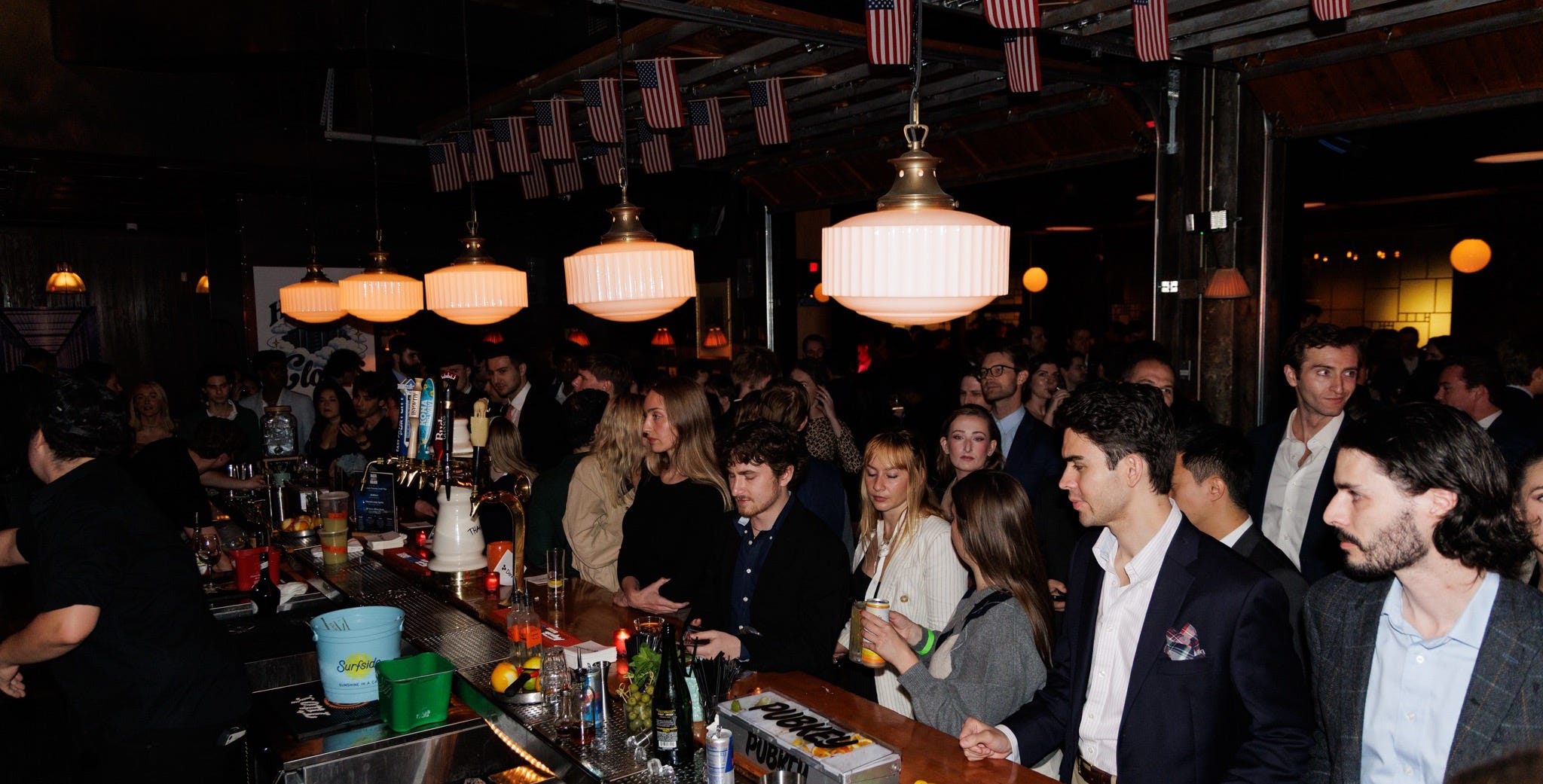
Of all the critical coverage I’ve seen of Data After Dark so far—a party I was proud to co-host and The Compute Optimist proud to co-present—perhaps my favorite genre is the assertion that a themed party in Washington, DC did not, in a single evening, reverse American public opinion on data centers.
As Krystal Ball of Breaking Points put it, she “can’t imagine a single rural American” who would be persuaded because “some people in DC had a cocktail party.” Her co-host, Saagar Enjeti, added, “Generally, just some advice, that’s not really how you move the needle.”
I appreciate the advice, Saagar, and I’m glad we can at least agree that, as you mentioned on the show, in-person socialization is good. But the value of the party was never that people would hear about a pro-data center party in the nation’s capital and suddenly see the light on the importance of the data center buildout. Nor have we ever argued that data centers belong anywhere and everywhere.
The value of Data After Dark lies in something much deeper.
What started as two friends and me planning a themed house party quickly grew into something far bigger. Within about an hour, my co-hosts Jonas Du, Casey Given, and I posted Data After Dark on Partiful. By morning, about 100 of our friends had RSVP’d.
In the weeks and months leading up to that night, anti-data center fervor had reached a breaking point. Strikingly, a Gallup poll had found seven in ten Americans opposing the construction of “data centers for artificial intelligence in their local area.” Politicians, sensing the changing winds, were quick to respond.
The data center debate was something the three of us had all discussed with our friends countless times, and with great frustration. In my experience, much of the opposition is being driven by false or exaggerated claims, but not all of it. Many are also asking valid community questions, and tech companies will have to make their case in those towns. The issue? Whether rooted in legitimate concerns or misconceptions, many of these objections can be addressed through better information or technological solutions. Yet data center opposition was increasingly fueling support for radical and reactionary proposals like all-out moratoriums.
The first statewide data center moratorium was signed this summer, support for Vermont Sen. Bernie Sanders’ national moratorium expanded beyond its niche progressive origins to include a powerful committee ranking member, and midterm campaign ads were increasingly using past support for data center projects as a political weapon.
On August 20, I posted my frustration on X: “If not, in 30 years, we’ll be watching documentaries about how the Jane Fondas of today destroyed our standing as the world’s compute superpower. People will so obviously realize how wrong they were today.” This was a callback to watching documentaries with my dad as a kid detailing the history of nuclear energy in America. Collectively, those documentaries led me to discover that something I’d opposed out of fear and pessimism wasn’t what I thought it was.
Fear and pessimism are the right words. Fear of the unknown and pessimism about what emerging technologies could mean for the future. It’s a tale as old as time, with America’s data center and broader AI buildout as the latest iteration.
The exhaustion with the prevailing climate of fear and pessimism is, in my view, the spark that made Data After Dark go viral. When Jonas and I posted the party on X, we were having fun with it. And we both knew those exhausted by the constant and growing negativity surrounding what they understand to be critical infrastructure would get a kick out of the themed party. We just didn’t realize quite how much of a kick.
With the screenshot of the Partiful invite, Jonas posted “Who wants to come to my pro-data center party in DC” to which I immediately reposted with “Yes, we’re hosting a pro-data center party in DC next month… Yes, we will be serving Loudoun County Ice Teas.” It didn’t take long for both posts to catch fire, with Jonas’s post drawing more than 322,000 views and mine more than 52,000.
“Based on the replies this is becoming the event of the season,” said Taylor Lorenz. “lfg. I’m there,” posted @/ira_quint. “Flying back to DC for this,” stated Nahom Sisay.
It quickly became clear that Jonas’s 900-square-foot DC row house, where we initially planned to co-host the party, was not going to fit everyone who wanted to come.
Among the responses were tech startup builders and nonprofits graciously jumping in to offer their support. We had clearly tapped into something, and they wanted to make sure capacity wouldn’t keep it confined to a row house.
That something was a yearning for optimism. AI is poised to deliver immense value for humanity, and those who recognize it are increasingly fatigued not only by the continuing proliferation of fear-based doomerism, but by how open excitement about technological progress is often met with scolding and unfounded accusations ranging from disregarding the environment to “shilling for big tech.” In a way, for many, that optimism was becoming a form of rebellion.
“It really is our generation’s Industrial Revolution, but bigger,” I told VICE in an interview about the party last week. “The risk of slowing down is far greater than pushing forward.” And this is the greater point. In throwing this party, our message was simple: You’re allowed to be excited and optimistic about the remarkable and innovative things happening in American tech right now. What Data After Dark revealed was that the doomers do not have a monopoly on the energy and sentiment toward tech. There is a robust constituency for techno-optimism, and that constituency is hungry to express it.
The tech and politico worlds came together in a novel way that Saturday night: not over stuffy Hill meetings, rubber-chicken dinners, or a name-tagged networking event, but in the whisky lounge, over live jazz, and while dancing under a flag with the words “Come And Take It” beneath the image of a data center server.
While the typical DC crowd was certainly represented, Data After Dark was far from limited to it. I should know—I organize monthly happy hours and policy panels in the city. It enabled communicators, policy wonks, and startup builders to converge outside the usual professional circles. Not merely to “network,” but to get to know one another, celebrate optimism for the future, and yes, have fun.
No one in that room needed convincing that data centers have a PR problem. What they needed was to know one another. Professionals approaching the issue from different parts of the tech and policy worlds, who might otherwise never have met, are now acquainted. And from my conversations with friends, old and new, those relationships are already continuing and evolving beyond the party.
Finally, while much of the media coverage carried a negative flavor, the party provided a platform for getting out our message about optimism and innovation. If the SMRtini, named after small modular reactors (SMRs) to highlight one answer to data center grid concerns, or the Closed-Loop Spritz, named after closed-loop cooling systems to highlight how innovation is enabling data centers to recycle and reuse water, prompted even one conversation about these solutions, I’d call that a win. And when it came to optimism, one moment captured the contrast perfectly.
The protesters who stormed the stage put the divide between optimism and pessimism on full display. When the crowd broke into chants of “USA!” in response, I quickly joined my friend Jonas on the stage to help carry the chant. Photos and videos captured the two of us holding the microphone, smiling, laughing, and chanting alongside the crowd. Next to us, a protester shouted back at the attendees, at one point giving them the finger.
And that’s the contrast. The techno-optimists are having fun. And optimism is how we win.
Ed Tarnowski is the Founder and Editor of The Compute Optimist. He is also a Resident Fellow, Technology and Innovation at the R Street Institute, a Senior Contributor at Young Voices, and the Washington, DC Regional Director for America’s Future. All opinions expressed are his own.